
Orthorexia symptoms can creep up so gradually that most people don’t notice until their world has become very small. If you ask yourself “Do I have orthorexia?”, you’ve come to the right place. In this blog I’m going to talk through what orthorexia and orthorexia nervosa are, key orthorexia symptoms and warning signs to look out for, and what to do next — including what a balanced, recovery-friendly diet actually looks like.
In my over 15 years as an eating disorder dietitian, I’ve seen the health and wellness space change quite dramatically. Terms like “clean eating,” “toxin-free living,” and “wellness” have become part of our vocabulary. On the surface, these sound like positive, health-conscious goals, and there can be some positives. But there is a point where this becomes an obsession and an extreme.
What is Orthorexia? Understanding the Symptoms
Orthorexia is somethings defined as healthy eating to the extreme. It’s an obsessive and extreme fixation on consuming only “pure” and “healthy” foods. The definition includes cutting out food and foods group, focusing on a “clean” diet and being slightly obsessed with the planning and nutritional content of meals and snacks.
The name Orthorexia Nervosa actually comes from the Greek word for “right” or “correct”. Although the term was first described back in 1997, it has become more well-known in recent years.
Orthorexia nervosa is when orthorexia becomes even more severe. Characterised by intense anxiety, distress around foods and a rigid set of rules you just can’t break without emotional overwhelm. This can lead to quite extreme dietary restriction and a lot of upset if certain foods have to be eaten. Plus a whole load of guilt, fear and shame.
Now, Orthorexia isn’t officially in the diagnostic manuals like Anorexia nervosa or Bulimia nervosa, but in my experience, it is just as real and just as damaging to your mental health, physical health and wellbeing. It isn’t about wanting to be thin (though it can be); it’s about an obsession with the purity of food. It’s a quiet, socially acceptable struggle.
If you’ve started to question “Do I have orthorexia” and you feel like your diet is your entire identity, I want to walk you through the orthorexia symptoms that suggest it’s time to step back and re-evaluate.
Orthorexia vs Healthy Living
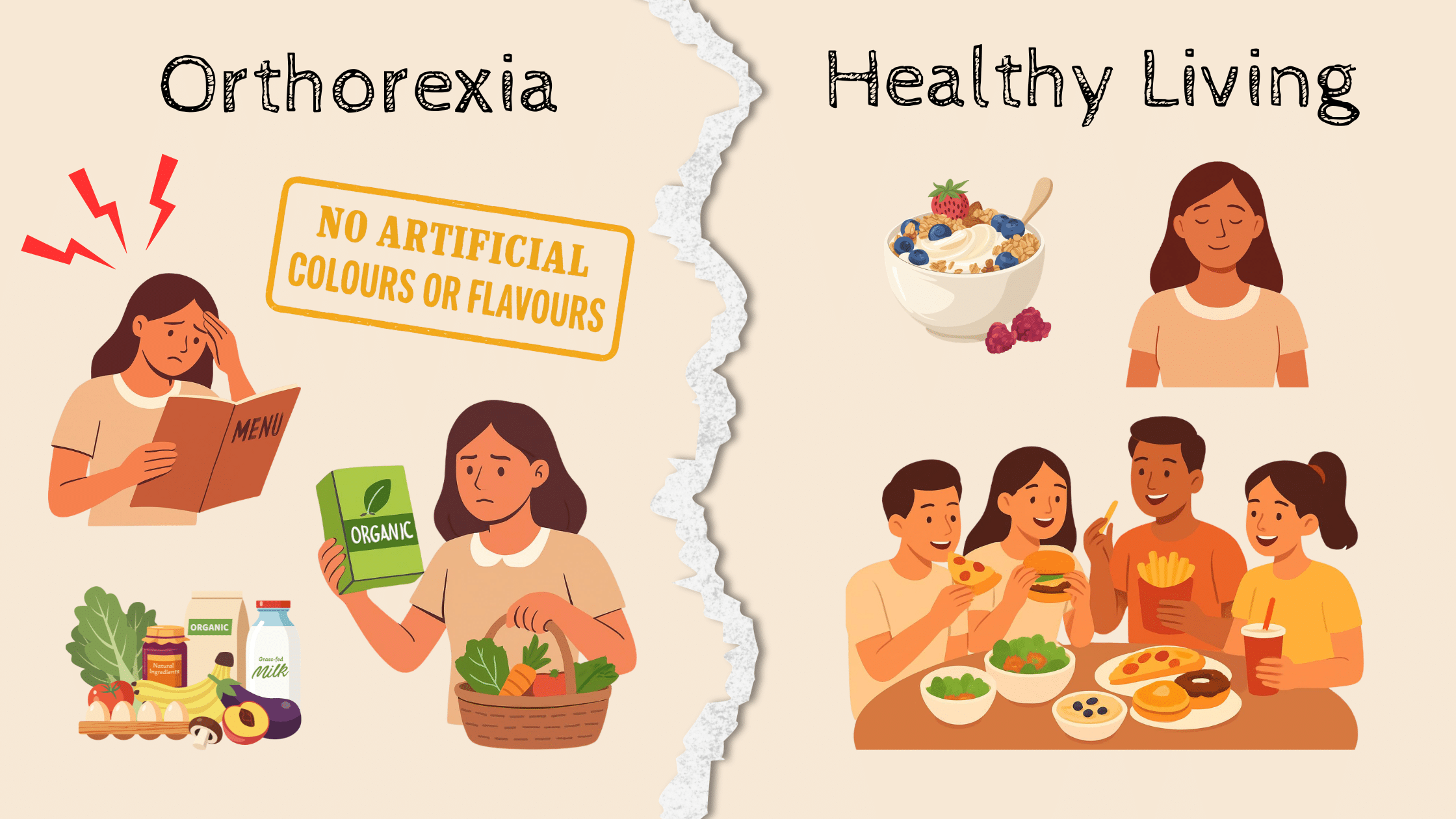
It’s worth being clear here: following a healthy, balanced diet does not mean you have orthorexia. Going gluten-free or vegan, for example, may be a legitimate ethical or medical choice for one person, and a sign of disordered restriction in another. What matters is the degree to which food rules impact your life and your mental health, not the food choices themselves.
Orthorexia tends to involve a gradual narrowing of “acceptable” foods over time. What starts as a sensible health goal can slowly become so restrictive that it actually becomes detrimental to your health. And often, the food rules are less about the food itself, and more about coping. They become a way to feel in control when other parts of life feel uncertain.
6 Orthorexia Symptoms: The Warning Signs Checklist
1. An Ever-Expanding List of “Forbidden” Foods
We’ve all heard of “cutting down” on certain things, but with orthorexia, the list of “bad” foods starts to expand rapidly. It often begins with something socially acceptable, maybe cutting out refined sugar or ultra-processed snacks. But then it can move to dairy, the all white carbs, then all carbs with any additives or artificial colourings. Then anything not organic, anything grown with pesticides, or anything packaged in plastic.
Suddenly you’re left with a tiny handful of “safe” foods, and strict black-and-white categories of “good” vs “bad.”
This rigid all-or-nothing thinking is a primary feature of orthorexia. Unlike someone with a genuine food allergy, a person with orthorexia experiences what feels like a genuine crisis if they accidentally consume a “forbidden” ingredient (NEDA).
In my practice, I talk a lot about “Food Neutrality.” This means all foods are good foods are allowed. You aren’t “good” for eating an apple and a biscuit isn’t “bad.” They are just different types of foods and some we eat more often than others. If you lived off biscuits you would start to feel pretty rubbish. But also eating too much fruit and veggies isn’t good for you. It is all about balance. When you lose the ability to see food as neutral, the rules start to run your life.
2. Food Obsession and Mental Load
How much of your brain space is currently occupied by food? What you are going to eat, how you will prep it, what you ate yesterday, what you are going to eat next week? For most people, food takes up a small percentage of daily thoughts, with bigger chunks given over to family, work, friends, and hobbies. For someone struggling with orthorexia, food can take up 70%, 80%, or even 90% of their headspace.
This can look like:
- Tracking, counting, weighing, and measuring everything and being unable to eat without scrutinising a label
- Planning meals days in advance with obsessive detail
- Spending hours reading clinical-sounding blogs or watching wellness influencers to validate food choices
- Worrying about “cross-contamination” from non-organic foods, oils or “toxic” cookware
Research consistently shows that this level of food obsession interferes significantly with relationships, work, and social life. When food prep and research consume more of your day than the people and activities you love, the balance has shifted.
3. Extreme Food Rules and Emotional Distress
A key orthorexia symptom is having rigid rules about what can and cannot be eaten. Breaking those rules (even accidentally) can trigger strong emotional responses: guilt, anxiety, overwhelm, stress, and feelings of being “unclean” or “impure.”
In the world of orthorexia, your self-worth can feel tied to your food. If you follow your rules, you feel “clean,” disciplined, and in control. But if you “slip up”, let’s say, by eating a piece of cake or a slice of white bread, then the repercussions can feel overwhelming and awful for days.
After a “bad” food choice, you might feel compelled to fast, do a “juice cleanse,” or go on a “detox” to compensate. I can tell you now that this isn’t necessary, and it isn’t normal. Your body is able to digest and process a varied diet without the need for purging or restriction afterwards.
4. The Loss of Your Social World
Food is a huge part of social connection. We celebrate birthdays with cake, catch up with friends over coffee, share pizza with friends, and gather for Sunday roasts with family. One of the clearest orthorexia symptoms is when your food habits start to isolate you and stop you being present, enjoying the moment. That is something I hear a lot from the people I work with in clinic. “I spent all my time worrying about the food and can’t enjoy being there”.
Do you find yourself:
- Scouring restaurant menus for hours before an event, only to decide you can’t eat anything there?
- Avoiding dinner parties because you don’t know exactly how the food was prepared?
- Feeling unable to grab a snack from a coffee shop because nothing on the menu fits your rules?
- Feeling a strong urge to “educate” friends who are eating processed food?
If your diet is making your social life smaller, it isn’t healthy. True health includes the joy of being with people you love, without panic and anxiety, without guilt, or going hungry.
5. Physical Orthorexia Symptoms: Your Health is Declining
This is the ultimate irony of orthorexia. People are trying so hard to be healthy that they actually make themselves unwell. By cutting out entire food groups (fats, carbs, dairy, grains), the body starts to shut down non-essential functions to save energy. Which on the surface will still make you feel like you are coping with life but longer term this will take a toll. Trust me I see this over and over again and I’ve even been there myself.
Physical warning signs I look for as a dietitian include:
- Constant fatigue: Your body doesn’t have the fuel it needs to function.
- Feeling cold all the time: Your metabolism is slowing down to conserve heat.
- Loss of period (Amenorrhea): Your hormones are out of balance because you aren’t eating enough energy or fats.
- Brittle hair and nails: Clear signs of micronutrient deficiencies.
- Getting ill more often than normal: A weakened immune system
These deficiencies (often calcium, essential fatty acids, and overall calorie shortfalls) can lead to anaemia, poor bone density, and hormonal disruption. If your “healthy” diet is making you feel rubbish, your body is asking for more variety.
6. Over Time, the Rules Get Stricter
Unlike a straightforward preference or lifestyle choice, orthorexia tends to escalate. The list of “safe” foods shrinks. New rules layer on top of old ones. What felt manageable six months ago now feels far too lax. This progressive narrowing, always in pursuit of a “purer” diet, is one of the key distinguishing features of orthorexia nervosa.
Orthorexia Symptoms and Social Media
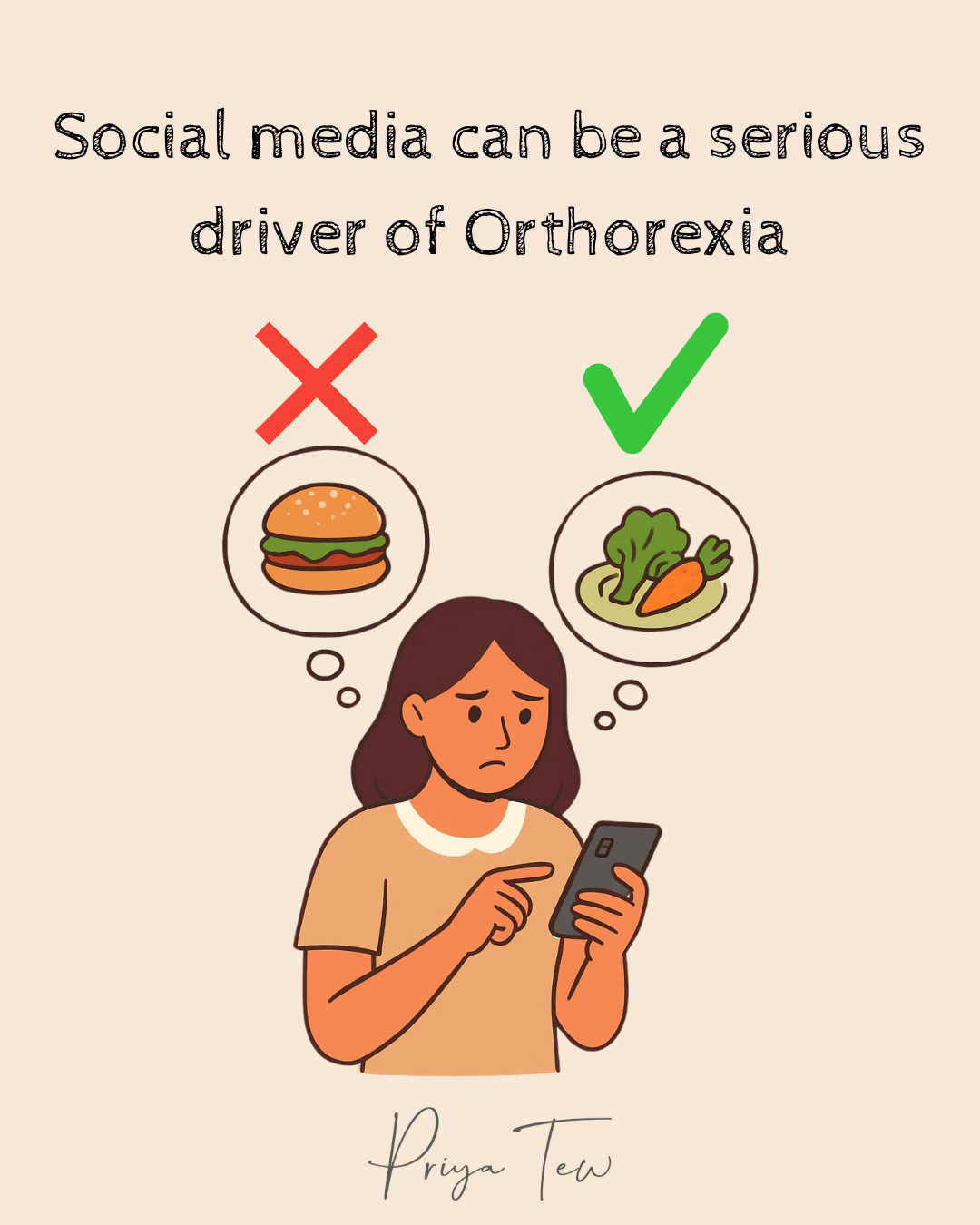
It would be impossible to talk about orthorexia symptoms in 2026 without talking about social media. Research published in 2025 confirms that the type of platform matters as much as the time spent on it, image-based platforms in particular are associated with higher orthorexic tendencies, through the promotion of idealised “pure” lifestyles around food, exercise, and wellness. Seeing “perfect bodies” and content that promotes thinner bodies as being the ideal can drive this.
Social media can make extreme restriction look aspirational, achievable, and virtuous. When you’re surrounded by content presenting a narrow, “clean” way of eating as the ultimate health goal, it’s easy to feel like you’re falling short, and to keep tightening the rules.
The good news? Research also notes that social media can play a role in supporting recovery, with communities offering connection and encouragement for those trying to rebuild a healthier relationship with food. It’s about being intentional about what you let into your feed.
What to Eat If You Have Orthorexia Symptoms
One of the most common questions I get from people starting to question their orthorexia symptoms is: if I stop following all my rules, what do I actually eat? The answer is simpler (and more freeing) than you might think. A balanced, recovery-supportive diet looks like this:
Eat regularly. Aim for three balanced meals and two to three snacks a day. Regular eating stabilises blood sugar, supports your metabolism, and reduces the anxiety spiral of going too long without food.
Include all the food groups. Every meal ideally contains a mix of:
- Carbohydrates (bread, pasta, rice, potatoes, oats): your brain and body’s primary fuel source. I promise carbs are good!
- Protein (meat, fish, eggs, beans, lentils, dairy, tofu): for repair and energy.
- Fats (olive oil, butter, avocado, nuts, cheese): essential for hormones, brain function, and absorbing fat-soluble vitamins.
- Fruit and/or vegetables: for fibre, vitamins, and minerals.
Nothing is off the menu. This is a principle I come back to again and again. All food is good food! Including all foods (yes, including cake, crisps, white bread, and takeaways), in a varied diet is not only fine, it is part of what it means to be a healthy person in the world. The goal is variety and balance over time, not purity at every meal.
Eat with other people when you can. Social eating is part of recovery. Shared meals help rebuild the idea that food is about nourishment and connection, not control. Let go of tracking. Start small. Try one meal a day without counting, measuring, or logging. Gradually, the goal is to eat according to hunger and enjoyment, not numbers.
Working with an eating disorder dietitian is enormously helpful here. We can help you work through fear foods, challenge black-and-white thinking, and build a meal plan that feels manageable, while also addressing the underlying anxiety and beliefs that have built up around food.
You can download my free What to Eat guide here.
Do I have Orthorexia? What to Do Now
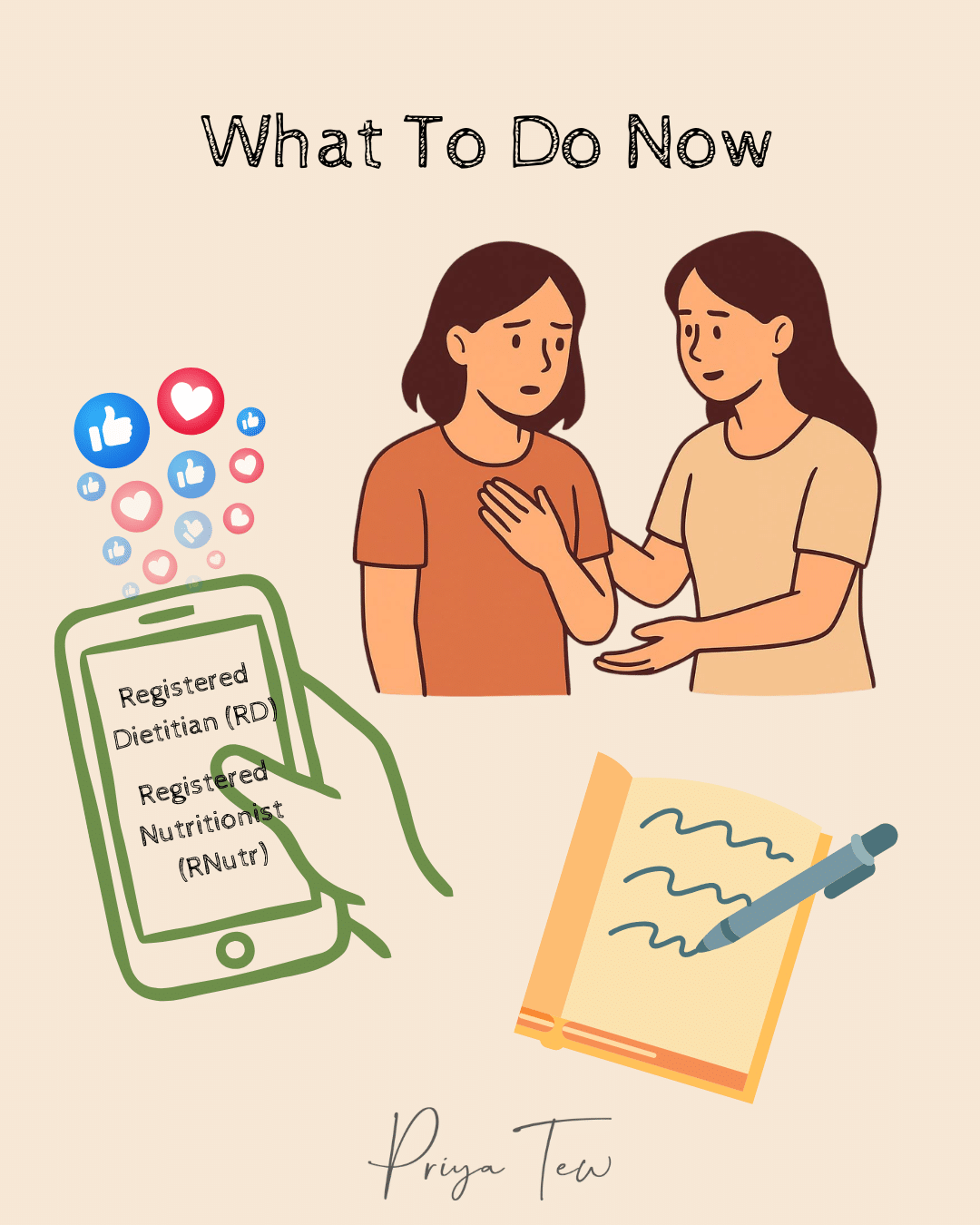
If you’ve read through these and felt a lump in your throat, please know that you are not alone and you are not stupid! This is a trap that many smart, health-conscious people fall into. But you can find your way out. Here are a few practical steps to start:
- Audit Your Feed: Go through your social media. If an account makes you feel “less than” or scared of food, hit unfollow. Your mental health is more important than their advice.
- Challenge One Rule: Pick one small food rule you have. Maybe it’s “no bread after 6pm” or “only organic apples.” Try breaking it once this week. Notice that the world doesn’t end.
- Talk to a Pro: Orthorexia is complex. Working with a dietitian who understands the psychology of eating can help you untangle the “rules” from the reality and rebuild a life around food that is flexible, joyful, and genuinely healthy.
- Write your rules down. Getting them out of your head and onto paper is the first step to challenging them.
- Seek only credible nutrition information. Get your nutrition knowledge from registered dietitians or registered nutritionists — people with a minimum of a degree-level qualification in nutrition. Not wellness influencers, not unqualified bloggers.
You Don’t Have to Do This Alone
Recovery isn’t just about eating “differently”, it’s about thinking differently. Whatever orthorexia symptoms you’ve recognised in yourself today, it’s about getting your life back.
Join The Recovery Tribe
I created The Recovery Tribe to be a safe haven for people who are tired of the rules. It’s a community where we share the ups and downs of recovery, learn the science of why our bodies need all foods, and support each other in a non-judgmental space. It’s about finding food freedom together.

Stay Supported with Weekly Emails
If you’re looking for a gentle way to stay on track, I’d love for you to sign up for my email list. I send out supportive, evidence-based notes designed to help you quiet that “orthorexic voice” and stay focused on what real health looks like, which is a life full of flexibility, joy, and, yes, the occasional slice of cake.
References
Cena, H., Barthels, F., Cuzzolaro, M., Bratman, S., Brytek-Matera, A., Dunn, T. M., et al. (2019). Definition and diagnostic criteria for orthorexia nervosa: A narrative review of the literature. Eating and Weight Disorders – Studies on Anorexia, Bulimia and Obesity, 24(2), 209–246.
Dunn, T. M., & Bratman, S. (2016). On orthorexia nervosa: A review of the literature and proposed diagnostic criteria. Eating Behaviors, 21, 11–17.
Donini, L. M., Barrada, J. R., Barthels, F., Dunn, T. M., Babeau, C., Brytek-Matera, A., et al. (2022). A consensus document on definition and diagnostic criteria for orthorexia nervosa. Eating and Weight Disorders, 27, 2985–3005.
Koven, N. S., & Abry, A. W. (2015). The clinical basis of orthorexia nervosa: Emerging perspectives. Neuropsychiatric Disease and Treatment, 11, 385–394.
Horovitz, O., & Argyrides, M. (2023). Orthorexia and orthorexia nervosa: A comprehensive examination of prevalence, risk factors, diagnosis, and treatment. Nutrients, 15(17), 3733.
Cheshire, A., Berry, M., & Fixsen, A. (2020). What are the key features of orthorexia nervosa and influences on its development? A qualitative investigation. Appetite, 155, 104798.
Zickgraf, H. F., & Barrada, J. R. (2021). Orthorexia nervosa vs. healthy orthorexia: Relationships with disordered eating, eating behavior, and healthy lifestyle choices. Eating and Weight Disorders, 26(6), 1933–1945.
Moccia, L., Anesini, M. B., Callovini, T., Janiri, D., Policola, C., Cintoni, M., et al. (2025). Understanding orthorexia nervosa: A systematic review of meta-analytical findings. Current Nutrition Reports, 14, 203–217.
Awad, E., Alleva, J. M., El Khoury, C., Chamma, N., Martijn, C., & Rizk, R. (2026). Orthorexia nervosa and social media: A mixed-methods scoping review using a systematic methodology. PLOS ONE, 21(3), e0300312.
McComb, S. E., & Mills, J. S. (2019). Orthorexia nervosa: A review of psychosocial risk factors. Appetite, 140, 50–75.