
17 Sept 2026
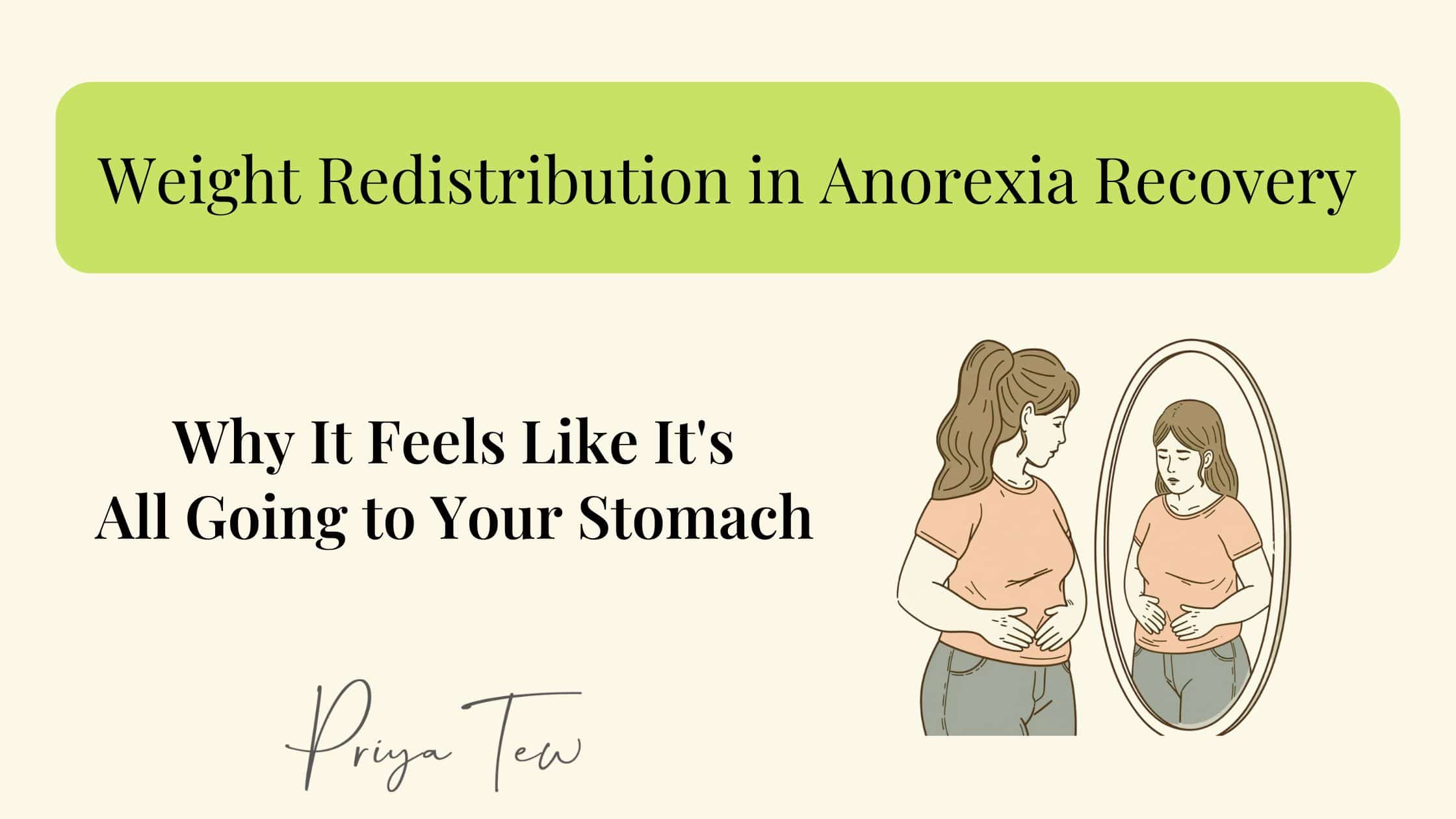
“It feels like all the weight is going to my stomach.”
This is one of the questions I get asked so often, by people in my clinic who are working on weight restoration. And it’s such a valid question. Which is why I’ve written this blog post for you: to share the evidence, give you the honest answer, and not just leave you with empty reassurance.
So yes. This can happen. You are not imagining it. You are not being dramatic for feeling that, as you weight restore, it’s going to your tummy more than anywhere else on your body. Your body may well be putting weight on around your middle first, faster and more visibly than anywhere else, during weight restoration.
I completely get how uncomfortable that feels, and how it can stop you wanting to work on weight restoration at all. So let this blog post tell you two things. Firstly, you’re not going mad. Secondly, this is not how the story ends. There is a biological reason for what’s happening, and your weight will redistribute, if you give it the time it needs.
Is it true, or does it just feel that way?
I want to start by looking at the research, because as a dietitian, I’m always informed by the evidence base.
Studies using MRI scans have looked at what happens to fat distribution when adult women regain weight after being underweight with anorexia. It’s worth flagging straight away that this is adult women, not teenagers, more on teenagers shortly. Adult women do initially show a higher waist-to-hip ratio and gain more fat around the tummy, compared to women who haven’t had anorexia.
One of the key studies here was conducted by Mayer and colleagues. It followed women in an inpatient unit recovering from anorexia over a 10 week treatment period. Over those 10 weeks, they gained 12.2kg, taking them back into a normal weight range, similar to the controls in the study. That is fast weight restoration. And it makes sense that your body is going to quickly store that energy somewhere easy. That tends to be centrally, around the tummy area. It’s the easiest, most efficient place for your body to store that weight.
So if this is what’s happening to you right now, it makes physiological sense. It isn’t a sign that something has gone wrong with your body, or with your recovery. It’s actually your body doing exactly what it should do under this kind of recovery pressure.
Keep reading to hear what happens in the rest of this study. Because, spoiler alert, there is good news coming.
Does this happen to everyone?
Here’s where we need to be careful, because the research isn’t the same in adult women as it is in adolescents. The research in adolescents is far more nuanced. Whilst weight can go to the tummy more in adult women, the research on teenagers shows it doesn’t tend to happen in the same way.
So for some teenagers, this won’t happen at all. For others, it will. Both fit with what the research shows us.
The speed of weight gain matters too. The studies I’ve mentioned, and the studies we have in the evidence base, are based on people restoring weight quickly in an inpatient unit. If you’re working in the community and gaining weight more gradually, this may be the same for you, but it could also be different.
The point of this blog post is to highlight that if you do feel this way, it can be a normal biological response, and it is something we know will change over time.
Why does the body do this first?
When you’ve been undernourished for a long time, your body doesn’t trust that you’re going to keep feeding it. It doesn’t know that food will keep coming in, day after day. It doesn’t know it can rely on you to give it adequate nutrition. So during that fast period of weight restoration, when it’s being given lots of nutrition, your body grabs hold of it as quickly as it can, as if it’s in an emergency. And its first job in an emergency is protecting your vital organs and keeping you alive, not thinking about where your body composition ends up in the long term.
Fat around the tummy region sits close to your vital organs. It’s quick and easy to lay down stores there, and quick for the body to draw on again when it needs to.
For example, your body is going to need energy, not just for weight restoration, but for healing as well. So when it feels like you are weight restoring, I want you to remember that weight, or fat mass, also equals energy. The energy to heal your bones. The energy to make hormones. The energy to make cells. The energy to keep your body powered.
So in the short term, that’s why this extra weight goes there first. It doesn’t mean it’s going to stay there. It’s your body looking after you, and trying to keep you safe. In the short term.
The good news: it does not stay there
This is the part I really want you to remember.
Because in this same research, using MRI studies, the women who had this central weight gain were followed up a year later. The researchers found the fat had redistributed over their body. They no longer had excess fat around their tummy. It had settled and normalised over that time period.
You see, your body isn’t out to get you. It doesn’t plan to leave that weight in one place forever. This early pattern is a holding stage. Let me explain further.
My washing basket way of explaining this
I have a way of explaining weight redistribution that I use with clients all the time, and it has nothing to do with fat cells.
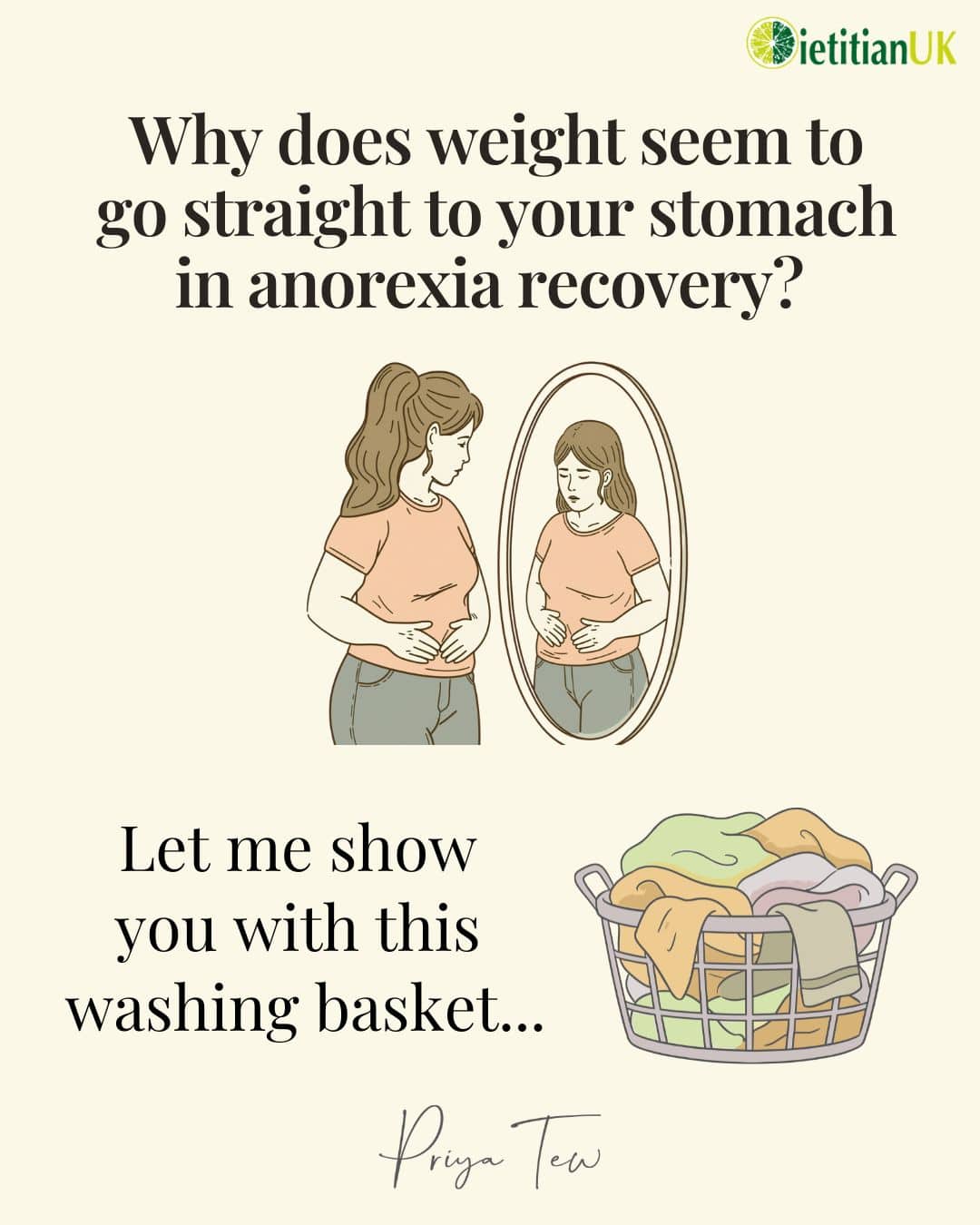
There are eight people in my house, which means an enormous amount of washing. When I bring it in off the line, it all goes into one basket and gets dumped on my landing. Every bit of it, all at once, in one overwhelming pile.
It sits there. Sometimes for a couple of days. That’s its holding space.
Then, over the week, I sort it, fold it, and take it round to each person’s bedroom door. Eventually, if I’m lucky, it makes it into the right drawers.
That pile on the landing was never where the washing lived. It’s just where it landed first, before it got moved to where it actually belonged.
Weight redistribution works the same way. That first stop, around your middle, is the landing. It is not the drawer. Give your body the time it needs to do the sorting.
What this means for you, right now
So if you’re sat there right now convinced that every ounce is going straight to your stomach, I’m not going to tell you it’s all in your head. It might genuinely be happening. And that is a hard, disorientating thing to live through while you’re also trying to eat enough, trust a process you can’t see the end of, and ignore a voice telling you this proves something has gone wrong.
It hasn’t. It proves your body is working exactly as bodies under this kind of strain tend to work, and that it has a plan for putting things right that doesn’t run on your timeline, or anorexia’s.
The key is to trust your body has the best plan here, and to keep going.
Quick answers
Does weight redistribute after anorexia recovery? Yes. Research following adult women a year after weight restoration found that central fat, initially gained around the stomach, had redistributed and normalised.
Why does weight go to the stomach first in recovery? Studies suggest it’s often about speed. When weight is regained quickly, the body tends to store it centrally first, as this can be the fastest and most protective place to lay it down.
Does weight redistribution happen for teenagers too? The evidence is less clear here. Research suggests this central pattern is less pronounced in adolescents than in adults.
Does gaining weight more slowly change this? It may do. The studies showing pronounced central weight gain involved fast weight restoration. Slower, more gradual weight gain may not produce the same dramatic pattern. However, depending on where your body is in recovery, it can be important to have faster weight restoration for your bones, your heart, and the whole of your body’s physical needs and physical safety.
Do you need more support?
Reading about this is one thing, but actually going through it is another. And you don’t have to do it without support.
If you’re restoring weight right now and the fear of it “all going to your stomach” is running the show, this is exactly the stage of recovery I work through with clients 1:1, the physical side of it and the thoughts that come with it. Book a consultation and let’s get you through this bit.
Sources