
Why ADHD Makes You Forget to Eat
By Priya Tew, Registered Dietitian
Why ADHD Makes You Forget to Eat is a complicated topic. ADHD and forgetting to eat go hand in hand for a lot of people, even when no one around you understands how that’s possible. “How do you forget to eat?” Maybe you’ve had that said to you, and maybe it’s left you wondering the same thing yourself. You’re not being dramatic, and I promise you are not the only one who does this. It’s actually one of the most common things I hear from clients with ADHD, and there’s a real, physiological reason behind it.
ADHD and Forgetting to Eat: Why the Hunger Signal Doesn’t Arrive
The word “forget” makes it sound like a lapse in memory, like leaving your keys somewhere. But for a lot of people, ADHD and forgetting to eat isn’t really about memory at all. You don’t forget and then remember. The signal telling you you’re hungry never really arrived, or it arrived so late and so faintly that by the time you noticed it, you’d already gone hours without food. Some people describe going most of a day, sometimes close to a full 24 hours, before it hits, and it hits hard: shaky, faint, unable to think straight.
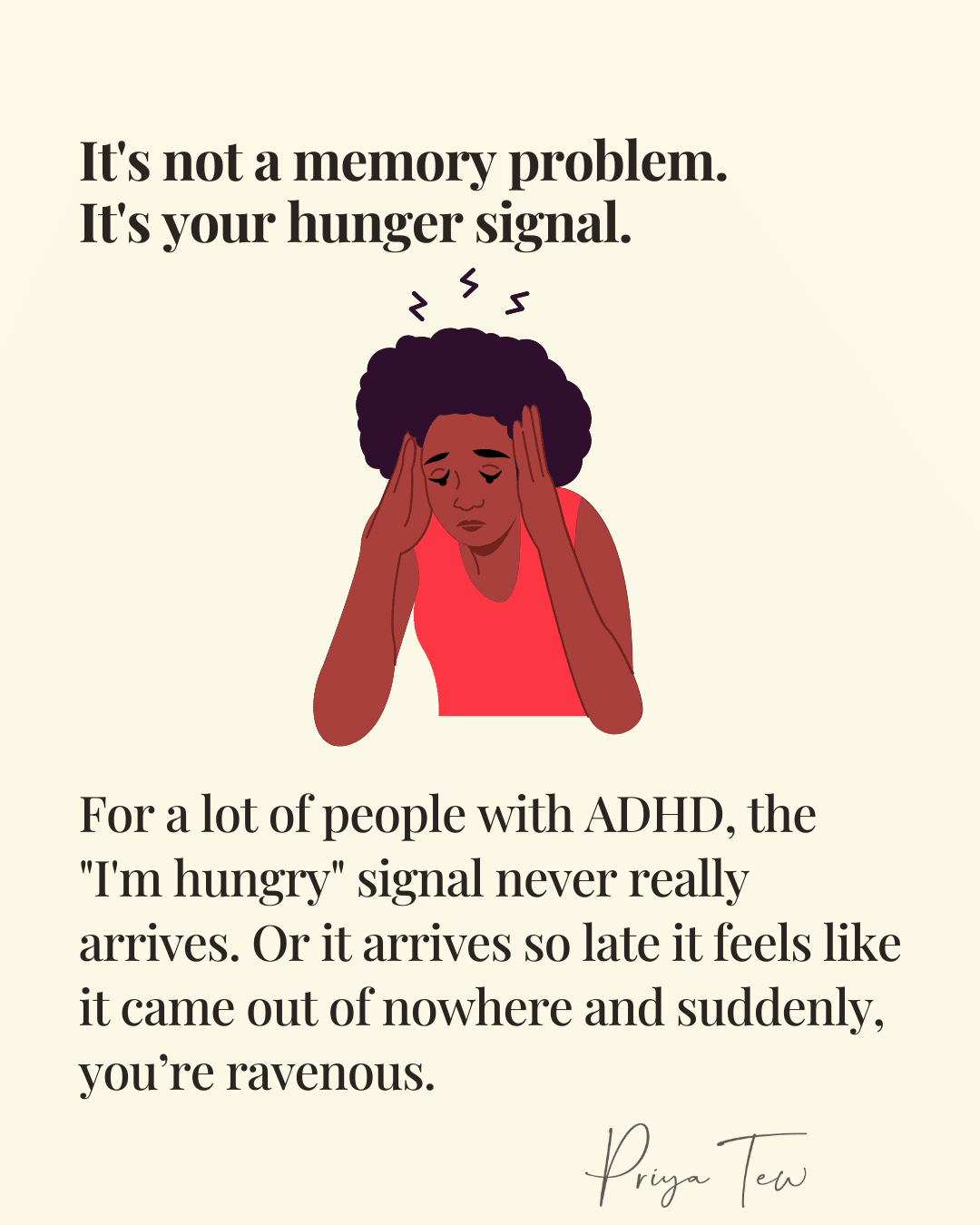
This comes down to interoception – your ability to sense and interpret internal body signals like hunger, fullness, thirst and tiredness. Research consistently links ADHD with reduced interoceptive awareness, which makes hunger cues easy to miss entirely until they show up as something far more dramatic than a quiet stomach rumble. One longitudinal study of adults found that disrupted reliance on hunger and satiety cues specifically explained the link between inattentive ADHD symptoms and less regular meal patterns and more disrupted eating routines. This isn’t a memory problem. It’s a signal-detection problem.
Why ADHD Makes You Forget to Eat: Hyperfocus and Time Blindness
Two other ADHD traits can be added on top of interoception difficulties.
Hyperfocus. When you’re deep in a task, your brain can effectively mute background signals, hunger included. You’re not ignoring your body, your brain genuinely isn’t registering the cue.
Time blindness. ADHD affects how time is perceived and tracked. Without an external reminder (an alarm, a set mealtime, someone else eating nearby), hours can pass without you noticing. “I’ll eat in a bit” can very easily become 6 hours later and then you are really hungry.
You Prep Food and Still Forget to Eat It
Meal prep is often the standard advice given to people who struggle to eat regularly. Cook in advance, and the hardest part is done, all you need to do is heat it up. But if the core problem is forgetting to eat, then having food ready doesn’t always fix that.
For example, you batch-cook on Sunday with every intention of eating well through the week. Then a few days pass, you’re deep into something else, time gets away from you and the meals are still sitting there, untouched, quietly going off in the fridge. It’s not that the plan was bad, but the hunger cue never arrives. This doesn’t switch off just because there’s food ready and waiting. Having a meal prepped removes the cooking step, but it doesn’t remove the noticing step, and that’s the one that was missing all along.
That’s why the fix to this usually isn’t “prepare more.” It’s building in an external reminder to prompt you to actually stop and eat whats prepared.
Does ADHD Medication Make Forgetting to Eat Worse?
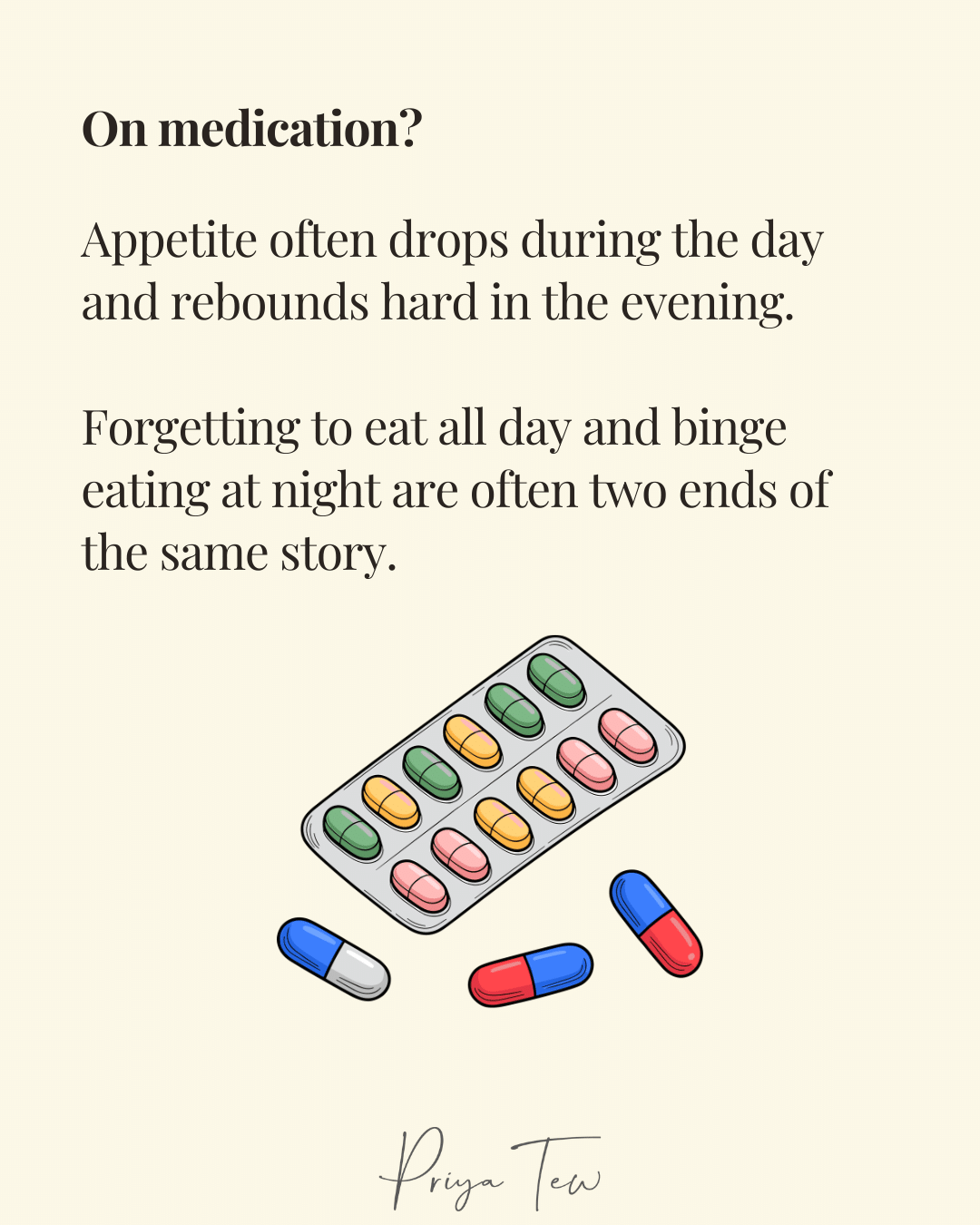
If you take a stimulant medication for ADHD, this pattern can become more pronounced.
Stimulants commonly suppress appetite. Many people feel genuinely little hunger for hours during the day. Some describe eating nothing until the medication wears off in the evening, or the next day.
That’s when appetite can return, sometimes intensely. For some, this tips into eating a lot in a short window once the medication has worn off. This is a well-recognised effect, it means the “forget to eat all day” pattern and the evening hunger are often two ends of the same story. If this cycle sounds familiar, I’ve written more about binge eating at night here. If medication timing is part of it for you, it’s also worth flagging to whoever prescribes it, so eating can be planned around it rather than left to chance.
When It’s the Opposite: Food You Can’t Ignore
Not everyone with ADHD struggles with forgetting to eat, some struggle to stop noticing food. A constant pull towards food, grazing that’s hard to switch off, or eating that’s driven more by dopamine-seeking than by actual hunger.
Both this and the forgetting pattern come from the same underlying differences in interoception, impulse control and reward regulation. They’re not contradictory, they’re two expressions of the same wiring, and it’s common for the same person to experience both at different times.
If either pattern is something you recognise, my practical strategies for ADHD and eating disorders covers ways to build more stable routines around both. Help is available.
What Actually Helps with ADHD and Forgetting to Eat
You can’t force a hunger cue to arrive on time. So the goal isn’t “listen to your body better.” It’s building structure that doesn’t depend on the cue showing up at all.
- Eat by the clock, not by hunger. Set fixed times for meals and snacks and use a phone alarm, not memory or hunger, as the trigger.
- Plan around your medication. If mornings are appetite-free, prioritise an easy, protein-containing breakfast before taking medication, and expect a bigger appetite later rather than fighting it.
- Lower the barrier to eating. Keep low-prep food visibly accessible ( on the counter, in your bag, at your desk), so eating doesn’t require a decision at the moment your executive function is already stretched.
- Give prepped food an alarm, not just a fridge shelf. If batch-cooked meals keep getting forgotten, the food isn’t the missing piece, a prompt is. Set a specific reminder for “eat the thing you made,” separate from any general meal reminder.
- Pair eating with something you already do. Habit-stacking (eat when you sit down at your desk, eat when the kettle boils) gives your brain an external cue to lean on.
Common Questions About ADHD and Forgetting to Eat
Is it normal for ADHD to make you forget to eat? Yes. It’s one of the most consistently reported experiences among people with ADHD, linked to interoception, hyperfocus and time perception rather than everyday forgetfulness.
Why do I not feel hungry until I feel ill? This usually means hunger cues are arriving late or faintly rather than not at all. By the time they’re impossible to ignore, you may already be significantly under-fuelled.
Does ADHD medication make this worse? It can. Stimulant medications commonly suppress appetite during the day, with hunger often returning strongly once the medication wears off.
Can forgetting to eat and binge eating happen in the same person? Yes. A long gap without food followed by binge eating at night is a very common pattern. You can grab my free ‘binge proof plate’ here.
Why do I batch-cook meals and then forget to eat them? This usually isn’t about the food or the plan, it’s that having food ready doesn’t create the cue to stop and eat it. The hunger signal that was missing before is still missing.
Do You Need More Support?
If mealtimes feel unpredictable, exhausting, or like something you’re constantly failing at, you’re not lacking discipline. You’re working with a brain that needs a different kind of structure around food.
This is exactly the pattern I work through with clients 1:1. Book a consultation and let’s build something that works for you.
References
- Bayoumi, S.C., Halkett, A., Miller, M. and Hinshaw, S.P. (2025). Food selectivity and eating difficulties in adults with autism and/or ADHD. Autism, 29(6), pp.1497–1509. doi:10.1177/13623613251314223.
- Cortese, S., Bernardina, B.D. and Mouren, M.-C. (2008). Attention-deficit/hyperactivity disorder (ADHD) and binge eating. Nutrition Reviews, [online] 65(9), pp.404–411. doi:10.1111/j.1753-4887.2007.tb00318.x.
- El Archi, S., Cortese, S., Ballon, N., Réveillère, C., De Luca, A., Barrault, S. and Brunault, P. (2020). Negative affectivity and emotion dysregulation as mediators between ADHD and disordered eating: A systematic review. Nutrients, 12(11), p.3292. doi:10.3390/nu12113292.
- Finn, D.M., Menzel, J.E., Gray, E. and Schwartz, T. (2023). Pharmacotherapy for attention deficit/hyperactivity disorder in youth with avoidant restrictive food intake disorder: A case series of patients prescribed stimulant medication in a partial hospitalization program for eating disorders. Journal of Eating Disorders, 11(1). doi:10.1186/s40337-023-00954-1.
- Kaisari, P., Dourish, C.T., Rotshtein, P. and Higgs, S. (2018). Associations between core symptoms of attention deficit hyperactivity disorder and both binge and restrictive eating. Frontiers in Psychiatry, 9(103). doi:10.3389/fpsyt.2018.00103.
- Kream, R.M. (2014). Disruptive patterns of eating behaviors and associated lifestyles in males with ADHD. Medical Science Monitor, 20, pp.608–613. doi:10.12659/msm.890495.
- Levin, R.L. and Rawana, J.S. (2016). Attention-deficit/hyperactivity disorder and eating disorders across the lifespan: A systematic review of the literature. Clinical Psychology Review, 50, pp.22–36. doi:10.1016/j.cpr.2016.09.010.
- M. Bruton, A., Levy, L., Rai, N.K., Colgan, D.D. and M. Johnstone, J. (2025). Diminished interoceptive accuracy in attention‐deficit/hyperactivity disorder: A systematic review. Psychophysiology, 62(2). doi:10.1111/psyp.14750.
- Martin, E., Dourish, C.T. and Higgs, S. (2023). Interoceptive accuracy mediates the longitudinal relationship between attention deficit hyperactivity disorder (ADHD) inattentive symptoms and disordered eating in a community sample. Physiology & Behavior, [online] 268, p.114220. doi:10.1016/j.physbeh.2023.114220.