
How to stop bingeing at night is one of the common questions I get asked in clinic. It is also one of the most common eating patterns linked to disordered eating. Which can feel confusing and frustrating, especially when it happens despite your best intentions during the day.
You might eat “well” all day, stick to a plan, or stay busy enough not to think about food. But once the evening hits, it’s like a switch flips and you feel out of control. This is not a personal failing or a lack of willpower. In fact it is something that happens to a lot of people and instead of guilt and shame I want you to understand why it happens and offer yourself self compassion about it,
In this blog we’ll explore why bingeing at night happens, and share practical strategies on how to stop bingeing at night to break the cycle. There is a way out of this. I promise you are not alone, even though it may feel that way sometimes.
What Is Night-Time Binge Eating?
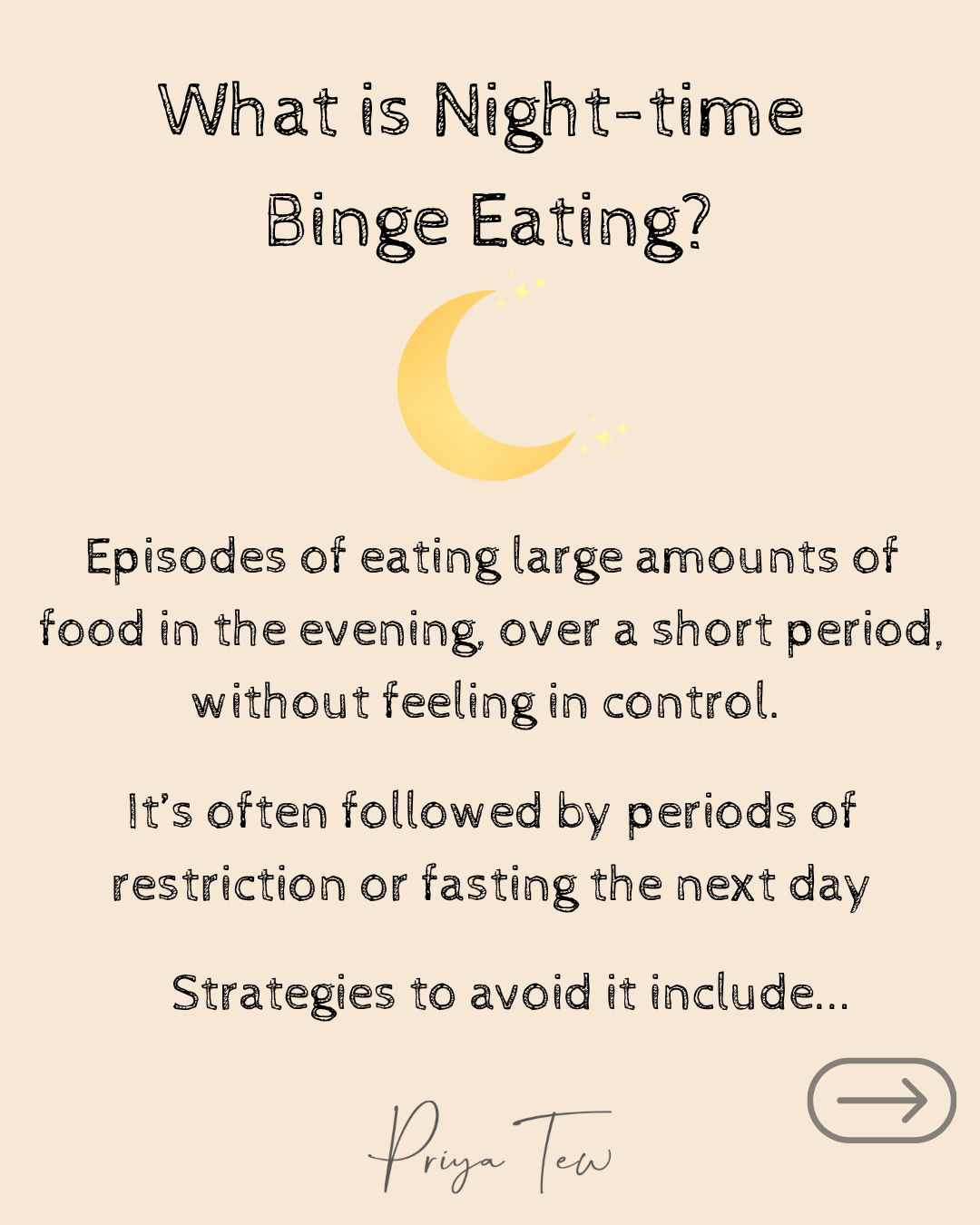
Binge eating at night refers to episodes of eating large amounts of food in the evening, over a short period of time, without feeling in control. For some, this may happen occasionally. For others, it can be a regular pattern, even happening daily. Being particularly prevalent when routines slow down and there is more time to think about food. For example at the end of the day, once work is done and your brain has more time to chill.
Binges involve eating more than intended in a short space of time, often even without feeling hungry. It is difficult to stop during a binge, you feel an intense urge to eat the planned amount and tp continue until feeling uncomfortably full. Binge eating is frequently associated with feelings of shame or guilt. This can lead to it being hidden from those around them, for example hiding the wrappers in a place no-one will find them. It’s often followed by periods of restriction or fasting the next day to “compensate” for the binge.
If you experience at least 3 episodes of bingeing per week, you may meet the criteria for Binge Eating Disorder. There is nothing to be ashamed of and it’s a lot more common than people think. Evidence suggests it’s actually more common than other eating disorders – it just isn’t talked about!
Why Does Binge Eating at Night Happen?
To answer the question of how to stop bingeing at night we have to start with the question why are those binges happening? Binge eating at night is rarely just about hunger. It is usually influenced by earlier eating patterns, emotional factors, and habits formed around food and routines. Understanding these underlying drivers can help make sense of the behaviour and reduce self-blame. So lets talk through some possibilities.
1. Undereating During the Day
One of the most common reasons for binges is not eating enough earlier on. Skipping meals, delaying eating, or restricting your intake can feel manageable and safe during the day. But by evening time, this can lead to intense hunger and strong cravings for quick, high-energy foods. Which means you are more likely to binge. So in this case bingeing in this context is a biological response to not having enough fuel at regular intervals. Your body needs routine and regularity.
2. Restriction & Food Rules
Restricting yourself of the foods you love can make them seem off limits and therefore more appealing. This can lead to craving that then turn to binges. Labelling foods as “good” or “bad” or even calling foods treats can lead to unhelpful food rules in our brains. This can create an all-or-nothing pattern, where eating a small amount triggers overeating. Then when those “treats” are available it becomes particularly challenging, leading to a binge eating episode followed by guilt and shame.
3. Emotional Triggers
Stress, boredom, and loneliness can become more noticeable once the distractions of the day are reduced. This can mean that when the evening arrives those binge episodes are more likely to happen, however much willpower you have. Food ends up binge used as a way to cope or distract from the uncomfortable feelings.
This is not a lack of discipline or self control. It instead shows how closely food and emotions are linked, particularly when other coping strategies feel out of reach.
4. Habit & Environment
Binge eating at night can become part of a routine. It is common to have certain activites that you associate with binge episodes, wich as sitting down to watch TV with snacks. Or hiding away after the children have gone to bed. This can create automatic patterns, even without hunger. Easy access to highly palatable foods reinforces this pattern, making it more likely to repeat.
Practical Tips on How to Stop Binge Eating at Night
Reducing binge eating at night is not about strict rules or relying on willpower. Making changes to your daily eating patterns and routines is key to breaking the cycle. So keep on reading for strategies that focus on supporting your body, reducing triggers, and creating more balanced habits around food.
Eat Enough During the Day
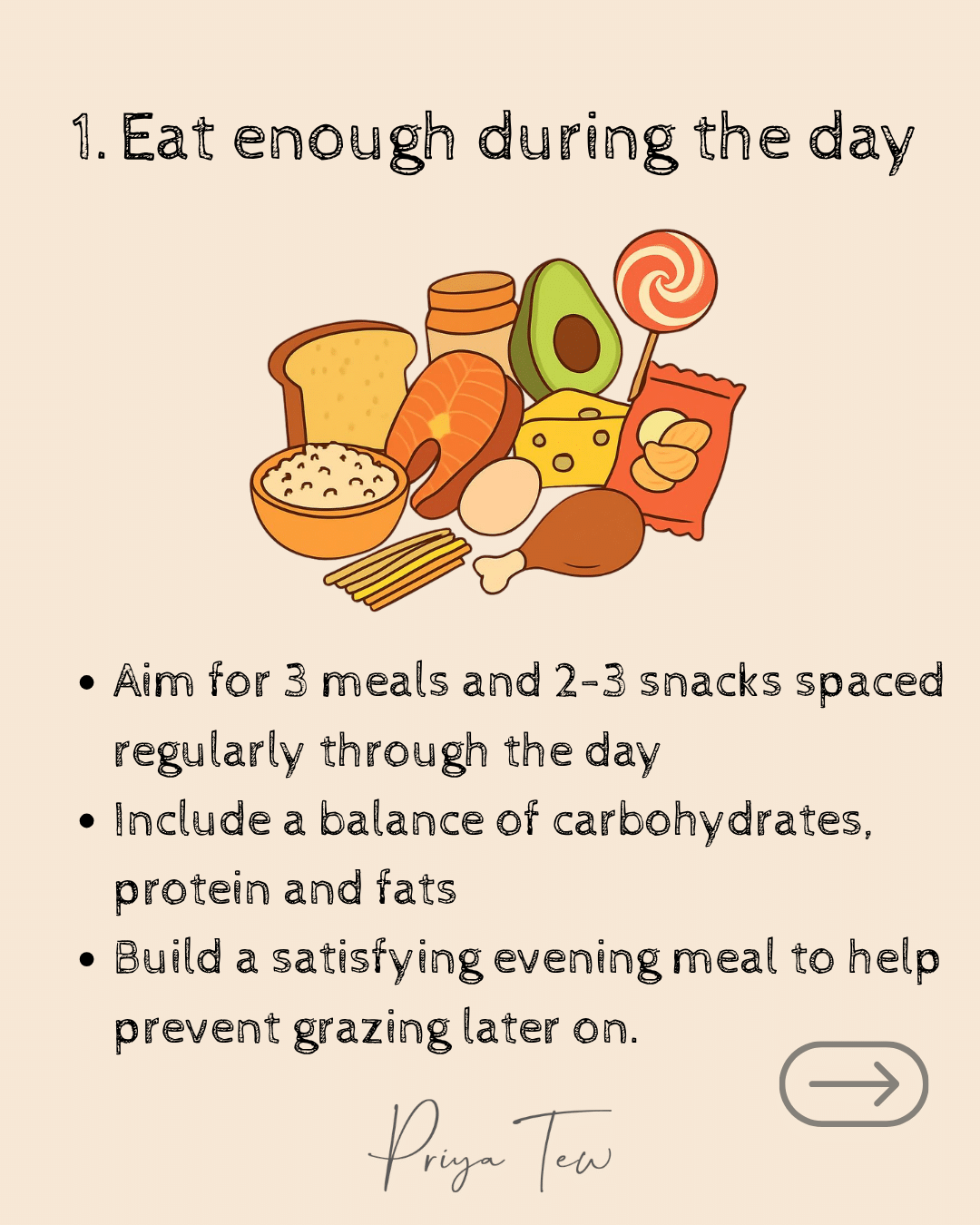
I know this can feel wrong to do. But even if you have binged it is essential to ensure you are eating regularly throughout the day . This really is one of the most important steps.
Aim for 3 balanced meals, plus 2-3 snacks spaced regularly across the day. Include a balance of carbohydrates, protein and fats to support energy levels and feel satisfied. Plus include some fun foods in your day – these are foods you love that are high in fat, sugar, salt such as cakes, biscuits, crisps. Whilst you don’t want to eat too many of these, restricting them can lead to those binges.
Building a satisfying evening meal is especially important to help prevent grazing later on. If meals feel too light or restrictive, it is common to find yourself looking for more food later in the evening. By eating enough it should help reduce feelings of hunger and cravings later in the day. Your body needs to feel safe and nourished.
Move Away from Restriction
Letting go of strict food rules can help reduce the binge-restrict cycle.
Allow all foods in a balanced way, including those that I call “fun foods”. This reduces the effect of urgently wanting those that are forbidden. This approach is not about eating without structure, but about creating flexibility within a balanced pattern.
If you struggle with food labels try this:
Choose a food you have labelled as “bad” and write down 1 neutral fact about it. For example:
“This give me energy to do fun activities”
“This is something I enjoy eating”
“This helps me feel satisfied when I include it in a meal”
The goal is not to force yourself to think of the food as “good”, but to move away from black-and-white thinking.
Identify Your Triggers
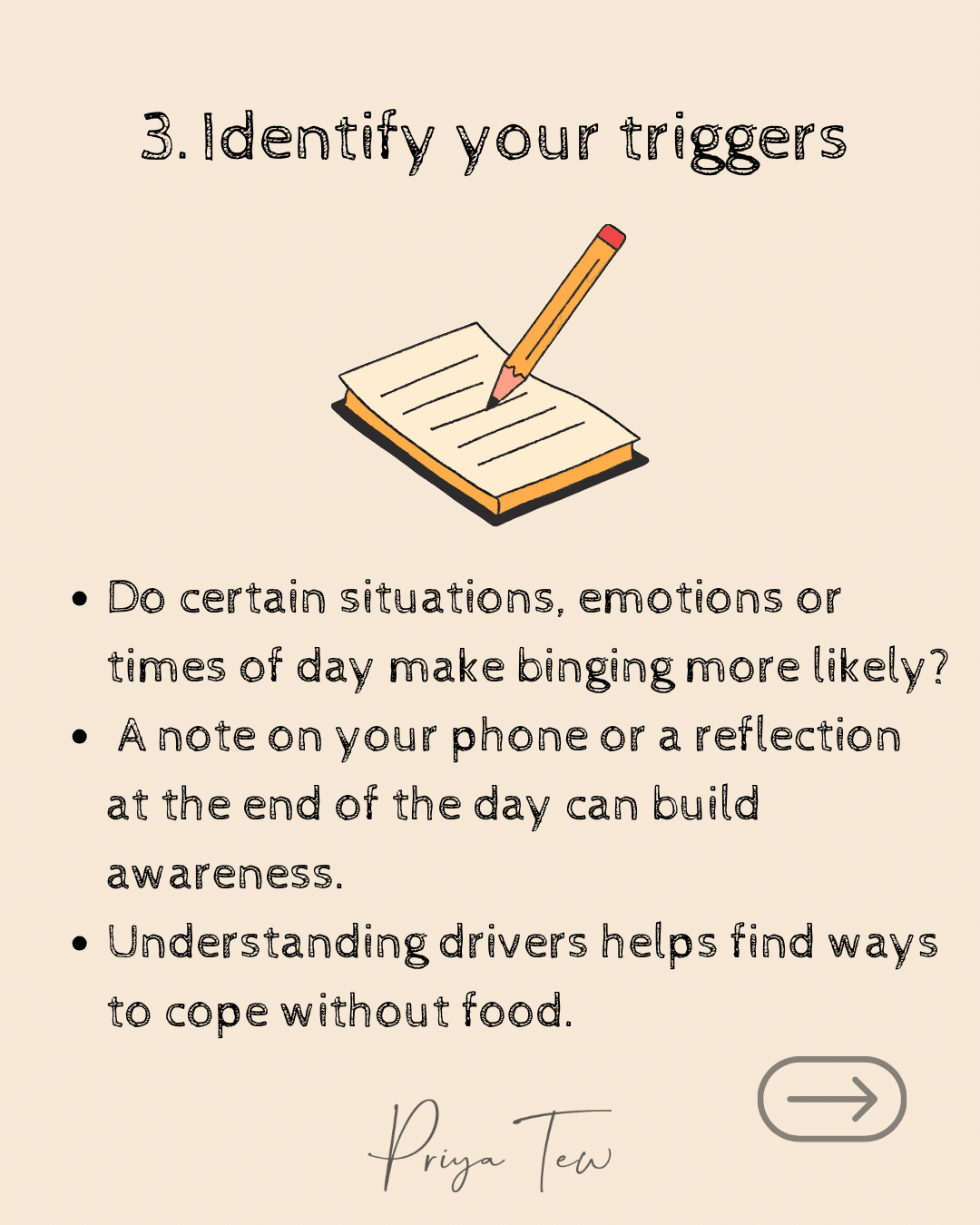
Taking time to notice patterns that lead to binging. Do certain situations, emotions or times of day make binge eating more likely? A simple note on your phone or a brief reflection at the end of the day can help build awareness.
Think about HALT: Was I Hunger, was I Anxious, Stressed or Emotional, was I Lonely or was I Tired and Bored.
It’s important to understand what may be driving the behaviour to help identify new ways to cope without food.
Create a Supportive Evening Routine
It can be helpful to introduce alternative habits to eating that support your needs.
Thinking about what drives the binges can help you work out how to meet your needs in a different way. For example if you are bored – can you find a new craft to take up, if you are lonely – who can you call, if you are tired – can you plan a relaxing bath and read in bed?
The goal is to create a comforting routine that does not revolve entirely around food.
Pause, Rather Than Restrict
If you feel the urge to eat, take a moment to pause before eating to check in with what you need. Ask yourself whether you are physically hungry, emotionally needing support, or following a routine?
If you do choose to eat, this should be without judgement. Changing patterns takes time, and let’s not forget that enjoying food is normal and that occasional overeating is normal too.
Try this Choice point reflection too:
Every moment in recovery gives you a choice:
- Move towards your values: freedom, health, connection, fun
- Move away from your values: restriction, isolation, and rigid rules
The Choice Point invites you to pause and ask:
“If I choose this right now, am I moving toward my values or away from them?”
Each time you pause and choose to move toward your values, you gain self trust and confidence.
What Not To Do
Certain approaches can unintentionally make the cycle worse.These patterns are often well-intentioned, but can reinforce restriction, increase hunger, or add to feelings of guilt.
It’s important to avoid:
- Skipping meals the next day to “make up for it”
- Relying on willpower alone to control eating
- Cutting out snacks or specific foods entirely
- Being overly critical or blaming yourself
A more consistent and compassionate approach is more effective over time.
How to stop bingeing at night: When to Seek Additional Support
For some people, binge eating at night can feel frequent, distressing, or difficult to manage alone.
If this is the case, seeking additional support can be an important step. Working with a registered dietitian or therapist can help you explore the underlying causes, rebuild regular eating patterns, and develop more supportive coping strategies.
If binge eating is significantly impacting your physical or mental wellbeing, or feels out of control, it is important to reach out for professional guidance.
You can also grab my “How to Manage Binge Eating Workbook” instantly here.
Or book a 1-1 Dietitian session with me here.
You do not have to manage this on your own.
Take Home Message
Binge eating at night is a common experience and is often driven by a combination of undereating, restriction, emotional factors and habit.
It is not a sign of failure or lack of willpower, but a response to what your body and mind have experienced throughout the day.
Focusing on regular, balanced eating, reducing restriction, and building supportive routines can help to gradually reduce these patterns over time.
Change does not happen overnight, but small, consistent steps can make a meaningful difference.
With the right support and approach, it is possible to develop a more stable and balanced relationship with food.
References
- Beat Eating Disorders. (2020). Beat Eating Disorders.org.uk.
- Forester, G., Schaefer, L.M., Dodd, D.R., Burr, E.K., Bartholomay, J., Berner, L.A., Crosby, R.D., Peterson, C.B., Crow, S.J., Engel, S.G. and Wonderlich, S.A. (2023). Time‐of‐day and day‐of‐week patterns of binge eating and relevant psychological vulnerabilities in binge‐eating disorder. International Journal of Eating Disorders, 56(9), pp.1694–1702. doi:https://doi.org/10.1002/eat.23995.
- McCuen-Wurst, C., Ruggieri, M. and Allison, K.C. (2017). Disordered eating and obesity: associations between binge-eating disorder, night-eating syndrome, and weight-related comorbidities. Annals of the New York Academy of Sciences, [online] 1411(1), pp.96–105. doi:https://doi.org/10.1111/nyas.13467.
- Striegel-Moore, R.H., Rosselli, F., Wilson, G.T., Perrin, N., Harvey, K. and DeBar, L. (2010). Nocturnal eating: Association with binge eating, obesity, and psychological distress. International Journal of Eating Disorders, 43(6), pp.520–526. doi:https://doi.org/10.1002/eat.20735.